Book a call
How the Instagram algorithm works in 2026, why saves and shares now drive reach, and the exact playbook to earn both. Formats, timing, captions, and mistakes.

Likes stopped being the game a long time ago. In 2026, two buttons decide your reach: save and share.
Instagram has been clear about this. Sends in DMs are now treated as one of the strongest signals of value the algorithm can read (Source: Sprout Social, 2026 — sproutsocial.com). On Explore, the actions Instagram predicts most are likes, saves, and shares (Source: Instagram, 2026 — about.instagram.com).
This changes how you should make content. Not "what gets a like" but "what gets saved" and "what gets sent to a friend."
This is the complete 2026 playbook. How the algorithm actually ranks content now. Why saves and shares became the signals that matter. And the exact moves that earn both — by format, by caption, by timing.
We run Instagram as a growth channel for brands across wellness, hospitality, D2C, and more. This is what we apply, not theory.
Start with the truth that kills most bad advice: there is no single Instagram algorithm. There are several, one per surface. Each surface uses its own algorithm tailored to how people use it (Source: Instagram, 2026 — about.instagram.com).
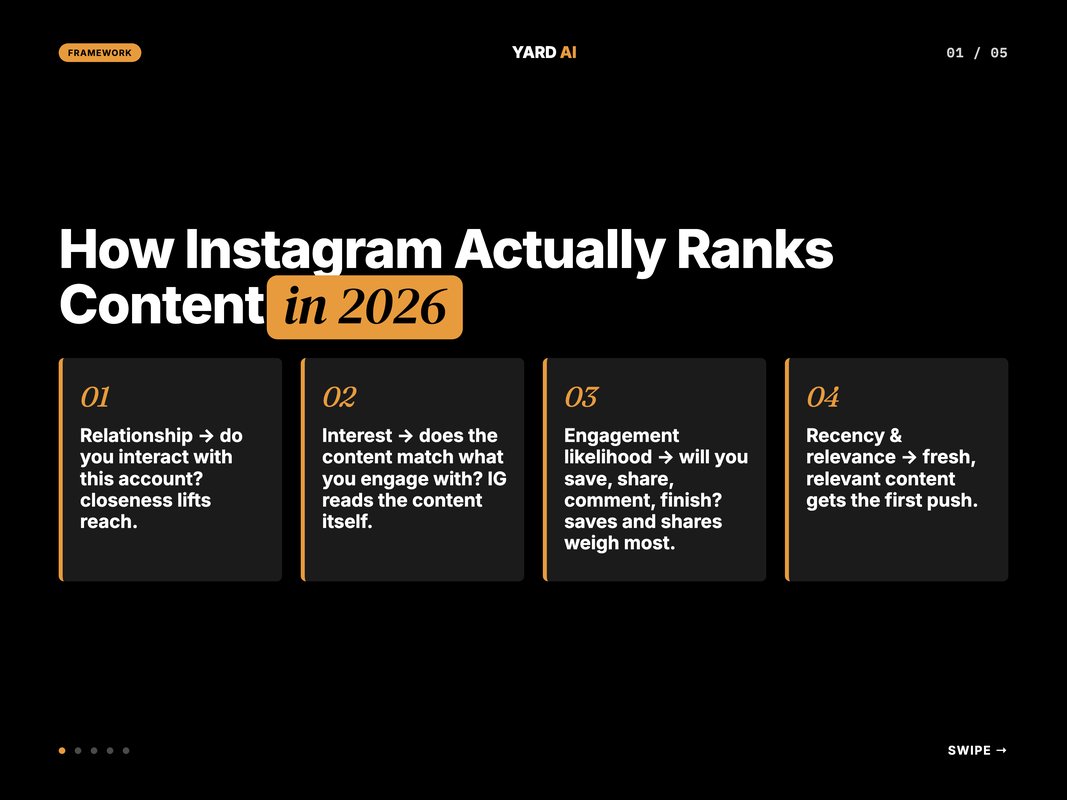
Feed, Reels, Stories, and Explore each rank differently. But they share the same core inputs. Instagram has described the main signals it weighs (Source: Instagram, 2026 — about.instagram.com).
Your relationship with the account. Do you interact with this creator? Stories you watch, accounts you DM, profiles you visit. Closeness lifts reach.
Interest. Does the content match what you usually engage with? Instagram reads the content itself — the audio, the objects, the topic — to predict interest.
Engagement likelihood. How likely are you to save, share, comment, or watch to the end? On Reels, the top predictions are how likely you are to reshare it and watch it all the way through (Source: Instagram, 2026 — about.instagram.com).
Recency and relevance. Fresh, relevant content gets the first push.
Q: Is there one algorithm I can "beat"?
A: No. There are several, and you do not beat them. You feed them the signals they reward — saves, shares, watch time, and meaningful interaction. Chasing hacks for a single ranking factor is how people waste a year. Feed the signals and reach follows.
The practical takeaway: stop optimising for likes. Optimise for the actions that tell Instagram your content has value worth spreading.
Think about what each action tells the algorithm.
A like is cheap. It costs a thumb tap and signals only that you noticed. A save signals you want to come back to it. A share signals that someone you know needs to see it. Those last two are votes of real value.
Instagram is in the business of keeping people on the app and bringing them back. Content that gets saved brings people back. Content that gets shared brings new people in. Of course the algorithm rewards them.
Quick Facts: Why Saves and Shares Win
- Sends via DM are the most heavily weighted signal for Reels distribution (Source: Buffer, 2026 — buffer.com).
- Sends and shares now rank among the most important signals across all surfaces (Source: Later, 2026 — later.com).
- On Explore, the actions Instagram predicts most are likes, saves, and shares (Source: Instagram, 2026 — about.instagram.com).
- Reels average a 2.46% engagement rate, the highest-reach format (Source: Sprout Social, 2026 — sproutsocial.com).Q: So should I stop caring about likes entirely?
A: Do not obsess over them. Likes are a soft positive signal and a vanity comfort. But if you had to choose what to engineer your content around, choose saves and shares every time. They are what actually move reach, and they correlate with business outcomes too.
The mindset shift is this. Before you publish, ask two questions. Would someone save this to use later? Would someone send this to a specific person? If the answer to both is no, rework it.
Reach is decided fast.
When you post, Instagram does not show it to everyone at once. It tests the post on a small slice of your most-likely-to-engage audience. How that slice responds decides whether the post gets a wider push.
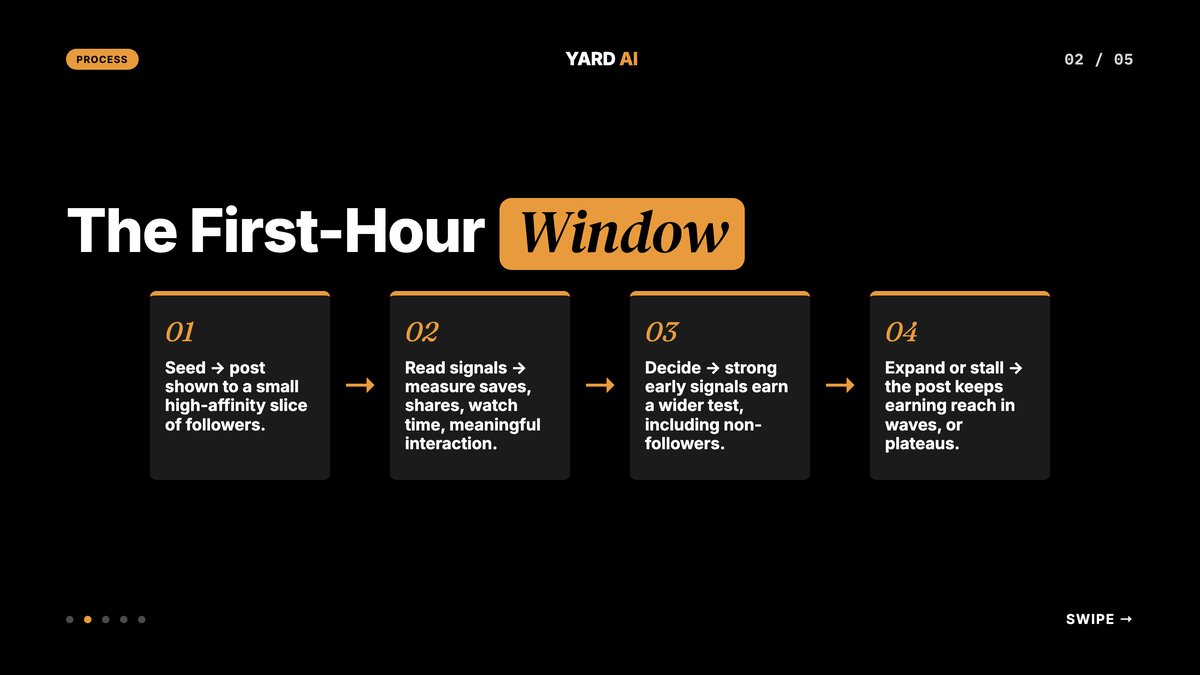
Here is the loop, simplified.
This is why the first window matters. Not because of a magic 60-minute rule, but because early signals set the trajectory.
Q: What should I actually do in the first hour?
A: Post when your audience is genuinely active so the seed slice is awake. Reply to every early comment to deepen interaction. Avoid editing the caption right after posting. And never buy engagement — fake early signals from low-quality accounts can hurt the test, not help it.
Do not confuse this with panic-posting. A great post published at a slightly wrong time still works. A weak post published at the perfect time still dies. Timing amplifies quality. It does not replace it.
The biggest mistake brands make is betting everything on one format. Each format has a job.
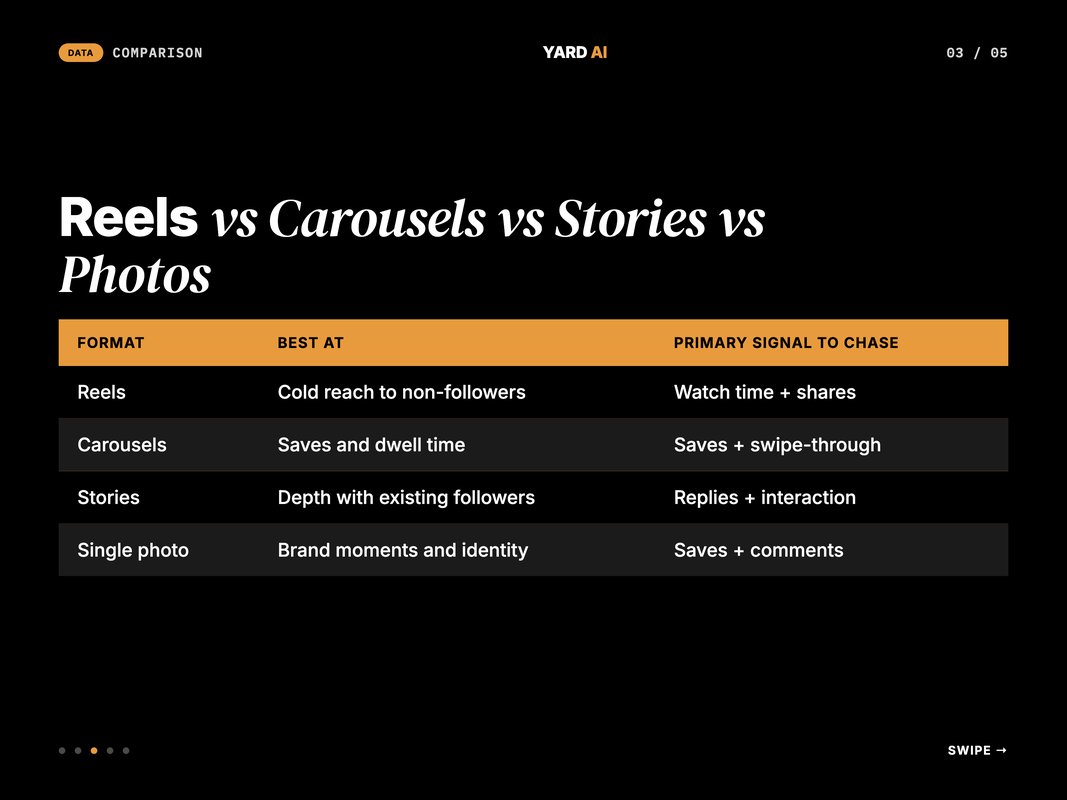
| Format | Best at | Primary signal to chase |
|---|---|---|
| Reels | Cold reach to non-followers | Watch time + shares |
| Carousels | Saves and dwell time | Saves + swipe-through |
| Stories | Depth with existing followers | Replies + interaction |
| Single photo | Brand moments and identity | Saves + comments |
Reels are still the widest reach engine because Instagram serves them aggressively to non-followers. Trial Reels even let creators show a Reel to non-followers first, before pushing it to existing fans (Source: Later, 2026 — later.com). If you want new audiences, Reels do that work. Chase a strong hook in the first second and a reason to rewatch or send.
Carousels are the save machines. Multiple slides mean more dwell time, and a well-built reference carousel. A framework, a checklist, a step-by-step — earns saves like nothing else. Design the last slide to be the keepable summary.
Stories are where you deepen the relationship with people who already follow you. Polls, questions, and quick replies build the closeness signal that lifts everything else.
Single photos are not dead. They carry brand identity and personality, and strong ones still earn saves and comments.
Q: If Reels get the most reach, why post anything else?
A: Because reach without depth does not build a brand or a business. Reels bring strangers in. Carousels make them save and trust you. Stories turn them into regulars. The mix is the strategy. Reels alone gives you a follower count and not much else.
The winning content plan uses each format for its strength. Reels to reach, carousels to save, stories to deepen.
Saves come from one feeling: "I will need this later."
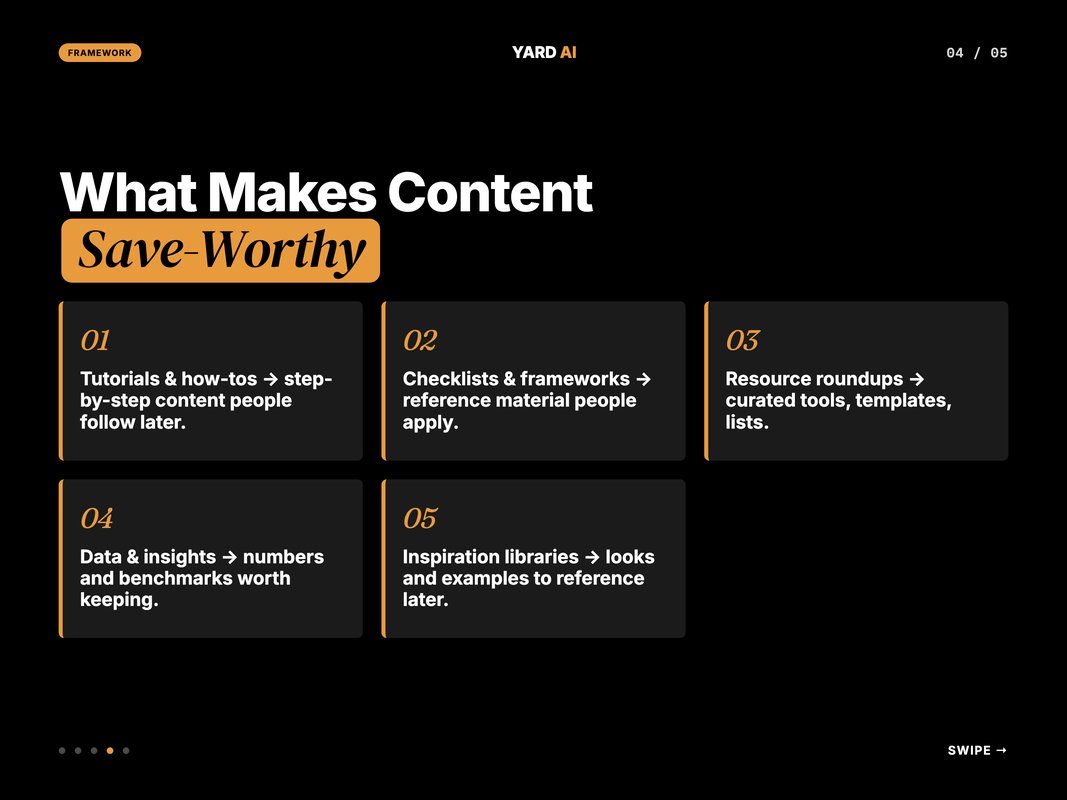
Five content types earn the most saves consistently.
One — Tutorials and how-tos. Step-by-step content people want to follow later. Recipes, setups, walkthroughs.
Two — Checklists and frameworks. Reference material. A clean list or a named model people want to apply.
Three — Resource roundups. "The 10 tools," "5 templates," "where to find X." Curation people return to.
Four — Data and insights. Numbers, benchmarks, and findings worth keeping for an argument or a decision.
Five — Inspiration libraries. Looks, designs, examples people save to reference when they create their own.
The common thread is utility. Entertaining content gets likes. Useful content gets saves. Saves matter because they sit among the top actions Instagram predicts on Explore (Source: Instagram, 2026 — about.instagram.com). If you want the save, give the viewer a reason to keep it. And often, just saying "save this for later" works, because it names the action.
Q: Can I make any post more save-worthy?
A: Yes. Add a takeaway the viewer would want to reference. Turn an opinion into a checklist. End a Reel or carousel with a one-line summary they can screenshot. The easiest save is the one where the value is obvious and the keepable bit is built in.
Shares come from a different feeling: "[specific person] needs to see this."
Saving is private and self-directed. Sharing is social and other-directed. They need different content.
Content gets sent in DMs when it triggers one of these:
Q: What is the single best test for share-worthiness?
A: Before you post, ask: would a viewer immediately think of one person to send this to? Not "would people like it" — would they think of a name. If the content makes a specific person pop into someone's head, it gets shared. If it is generic, it gets a like and scroll.
Relatable and opinionated content travels in DMs. Polished and impressive content gets admired and forgotten. Make things people want to forward, not just things people respect.
Instagram is now a search engine. People type queries into the search bar and Instagram returns posts and Reels that match.
That makes captions a discovery tool, not an afterthought.
Q: Are hashtags dead in 2026?
A: Not dead, but demoted. They are no longer a reach lever. Instagram's content understanding and keyword search do the heavy lifting now. Use a small set of accurate hashtags for context, then spend your real effort on the hook, the caption keywords, and the save-and-share value.
Treat every caption like a tiny piece of SEO. Clear topic, real keywords, strong hook. That is how you get found in search and recommended in feed.
More posts is not the answer. Better posts, consistently, is.
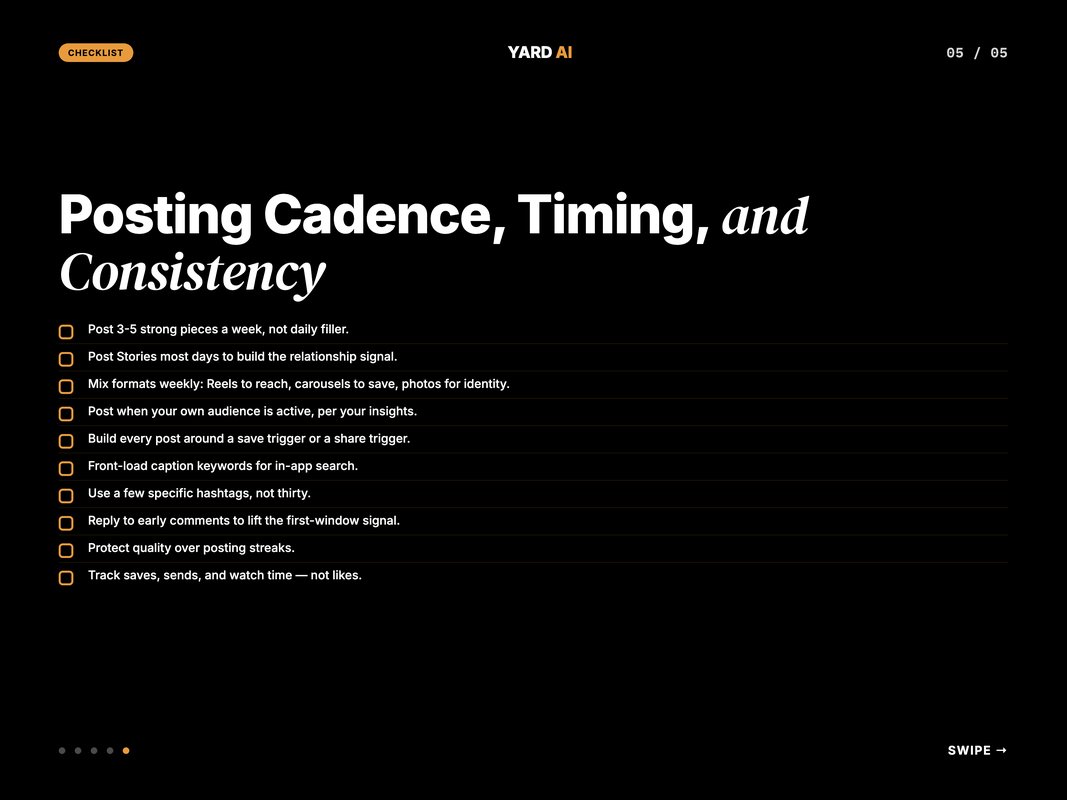
Here is the cadence that works for most brands.
Q: I can only post a few times a week. Am I doomed?
A: No — you are probably better positioned than the daily poster who sacrifices quality. Consistency means a steady, reliable rhythm you can sustain, at a quality bar that earns saves and shares. Three excellent posts a week, every week, beats fourteen forgettable ones.
Consistency is a quality-at-a-rhythm promise, not a volume race. Pick a cadence you can hold and make every post earn its place.
Most stalled accounts are making the same handful of mistakes.
Fix these in order and reach usually recovers without any new tricks.
We are an AI-first growth marketing agency. We run performance marketing, LLM SEO, AI creatives, and AI funnels for D2C and B2B brands.
We treat Instagram as a system, not a series of one-off posts. Every brand gets a format mix mapped to a goal: Reels for reach, carousels for saves, Stories for depth. Every post is built around a save trigger or a share trigger before a single pixel is designed.
Our content pipeline turns one idea into a Reel, a save-worthy carousel, and a set of Stories. Produced fast, reviewed by a human, and scheduled to land when each brand's audience is active. The signal we watch is not likes. It is saves, sends, and watch time.
For brands that switch from a like-chasing approach to a save-and-share approach, the pattern is consistent. Reach stops depending on follower count and starts depending on content value. That is a healthier, more durable kind of growth.
If your Instagram reach has flattened, the answer is almost never to post more. The answer is to make content people save and send.
Subscribe to the YARD newsletter for weekly platform-algorithm breakdowns.
The 2026 Instagram algorithm is not a mystery. It rewards the actions that prove your content has value: saves and shares.
Stop building for likes. Build for the save — useful, reference-worthy, keepable. Build for the share — relatable, opinionated, send-to-a-friend. Use Reels to reach, carousels to save, Stories to deepen. Write captions for search. Post consistently at a quality bar you can hold.
Do that and reach stops being a lottery. It becomes a function of how valuable your content is — which is exactly how it should work.
Pick your next post. Before you publish, ask the two questions. Would someone save this? Would someone send this? If not, rework it. That single habit changes your account.
What is the most important signal in the Instagram algorithm in 2026?
Sends per reach is the strongest signal. That means how often people share your post in DMs. Saves are a close second. Both tell the algorithm the content has lasting or shareable value. That is what pushes a post beyond your followers.
Do hashtags still matter on Instagram in 2026?
Far less than they used to. Hashtags are no longer a meaningful reach lever. Instagram now leans on content understanding and keywords for discovery. Use a handful of specific, relevant hashtags if you like. Put your energy into a strong hook, a searchable caption, and content worth saving.
How do I get more saves on Instagram?
Make content people want to return to. Tutorials, checklists, frameworks, resource lists, and reference carousels earn the most saves. Give a clear reason to save it — say it out loud, or design the last slide as a keepable summary. Useful beats entertaining for saves.
How do I get more shares on Instagram?
Make content people want to send to one specific person. Relatable observations, strong opinions, useful warnings, and "this is so us" moments get sent in DMs. The test is whether a viewer immediately thinks of a friend or colleague who needs to see it. If yes, they share.
Which format gets the most reach on Instagram in 2026?
Reels still drive the widest cold reach because they get served to non-followers. Carousels drive the most saves and dwell time. Stories drive depth with existing followers. The winning approach uses each for its strength rather than betting everything on one format.
How often should a brand post on Instagram in 2026?
Consistency beats volume. For most brands, three to five strong posts a week plus regular Stories outperforms daily mediocre posting. The algorithm rewards content that earns saves and shares, not raw frequency. Post less, but make each post worth saving.
Does the first hour after posting still matter?
Yes. Early engagement is a strong signal. Instagram tests a post on a small slice of your audience first. Strong saves, shares, and watch time in that window earn wider distribution. Post when your audience is active and prompt meaningful engagement early, not just likes.