Book a call
OpenAI's GPT-6.1 Terra costs $1 in and $5 out per million tokens, half of Sol, and beat Sol on an agent test. Here is what marketers should test first.
On 26 October 2026, OpenAI launched GPT-6.1 Terra (Source: Kingy AI, 2026 — GPT-6.1 Terra benchmarks and pricing). OpenAI shared the news in a launch post on its site.
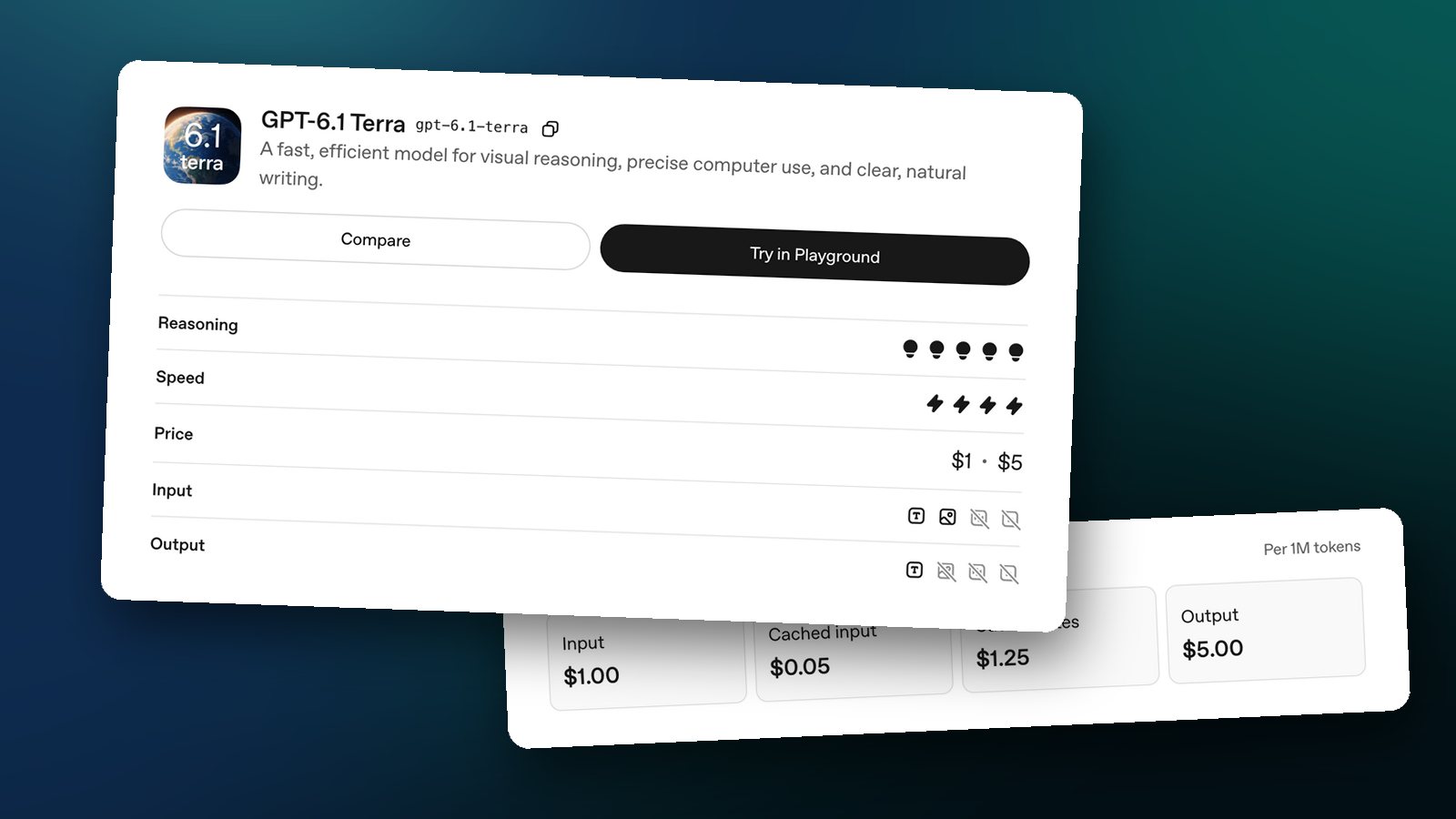
Terra is the middle model in OpenAI's range. It costs $1 per million input tokens and $5 per million output tokens. GPT-6.1 Sol, the model above it, costs $2 and $10 (Source: OpenAI, 2026 — GPT-6.1 Terra docs and GPT-6.1 Sol docs).
So Terra is exactly half the price of Sol. Cheaper models are usually weaker. This time, OpenAI's own chart says the cheaper model won.
On a test of real work tasks, Terra scored 60.0% at $1.01 per task. Sol scored 58.6% at $2.00 per task (Source: InfoWorld, 2026 — OpenAI's launch charts, as reported by InfoWorld).
There is one more reason a marketer should care. OpenAI's docs list the jobs Terra was built for. The first one is to match product photos to catalog entries.
That is a chore every online store knows well.
It is not the best model at everything, though. Claude Sonnet 5.5 still leads on screen work and coding, by a wide margin. We cover both sides below.
This piece reads OpenAI's docs, its launch charts as the press reported them, and one outside test. Where a number is OpenAI's own, we say so.
GPT-6.1 Terra replaces GPT-5.6 Terra. It sits between two other OpenAI models. GPT-6 Luna is cheaper. GPT-6.1 Sol and GPT-6 Astra are stronger and cost more (Source: InfoWorld, 2026 — launch report).
You can use it in two ways. Paid ChatGPT users on Plus, Pro, Enterprise and Edu plans get it in ChatGPT Work and Codex. Builders can call it in the API by the name gpt-6.1-terra (Source: InfoWorld, 2026 — launch report).
Kingy reports that GitHub and Amazon also added the model on launch day. So it may already be in tools your team uses (Source: Kingy AI, 2026 — availability notes).
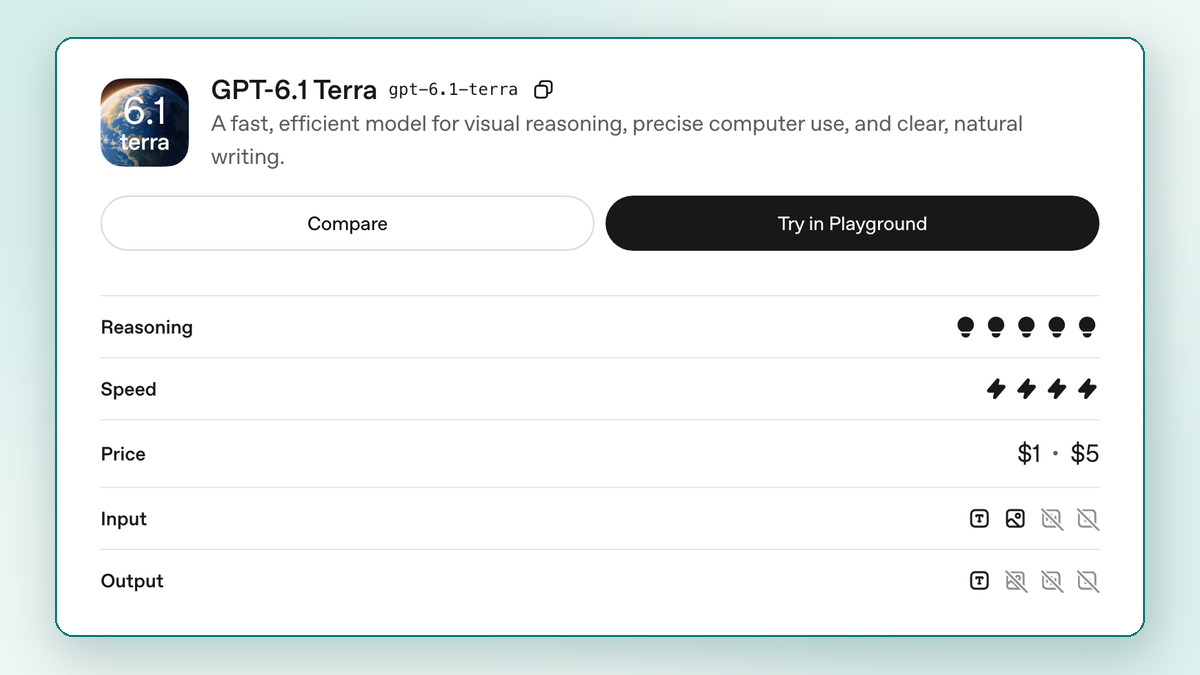
OpenAI's docs describe it in one line. It is "a fast, efficient model for visual reasoning, precise computer use, and clear, natural writing" (Source: OpenAI, 2026 — GPT-6.1 Terra docs).
In plain words, it is built for three things. It reads images well. It can click and type its way through apps. And it writes clean text.
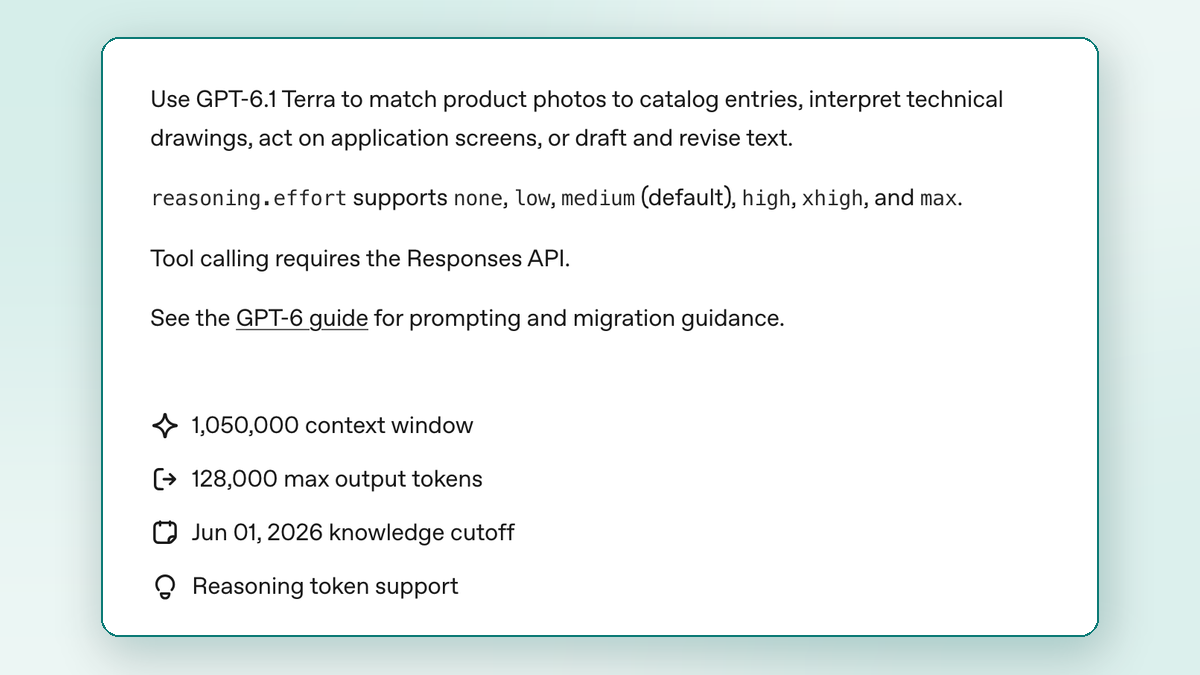
It can also take in a lot at once. Its context window is 1,050,000 tokens. It can write up to 128,000 tokens in one reply (Source: OpenAI, 2026 — GPT-6.1 Terra docs).
It takes text and images in, and it gives text back. Its knowledge stops at 1 June 2026 (Source: OpenAI, 2026 — GPT-6.1 Terra docs). So for anything newer, you need to give it the facts.
For a marketer, the image part matters most. Terra can read a product photo. It cannot make one.
Most model launches talk about code and science. Terra's docs page talks about a marketing team's day.
OpenAI's docs say to use Terra "to match product photos to catalog entries" and to "interpret technical drawings" too. They also name two more jobs. One is to "act on application screens." The other is to "draft and revise text" (Source: OpenAI, 2026 — GPT-6.1 Terra docs).
Read that list as a brand owner. Each item maps to a chore your team does by hand today.
Match product photos to catalog entries. Think of a new season's photo shoot. Someone has to tag each photo to the right product, colour and size.
Act on application screens. Think of copying product details into a marketplace seller panel. It is one field at a time, for every listing.
Draft and revise text. Think of product titles, bullet points and short descriptions.
OpenAI's charts back up the photo claim. On MMMU-Pro, a test of reasoning about images, Terra scored 85.5%. Sol scored 86.3% and Astra scored 86.7% (Source: InfoWorld, 2026 — OpenAI's launch charts).
The cost gap on that test is wide. Each task cost Terra $0.012. Each task cost Astra $0.065 (Source: InfoWorld, 2026 — OpenAI's launch charts).
So on images, Terra lands within about a point of OpenAI's top models. It does that at a fraction of the cost.
That is OpenAI's own test, not an outside one. But it fits what the docs promise.
API models are priced per token. A token is a small chunk of text, often part of a word. Prices are quoted per million tokens.
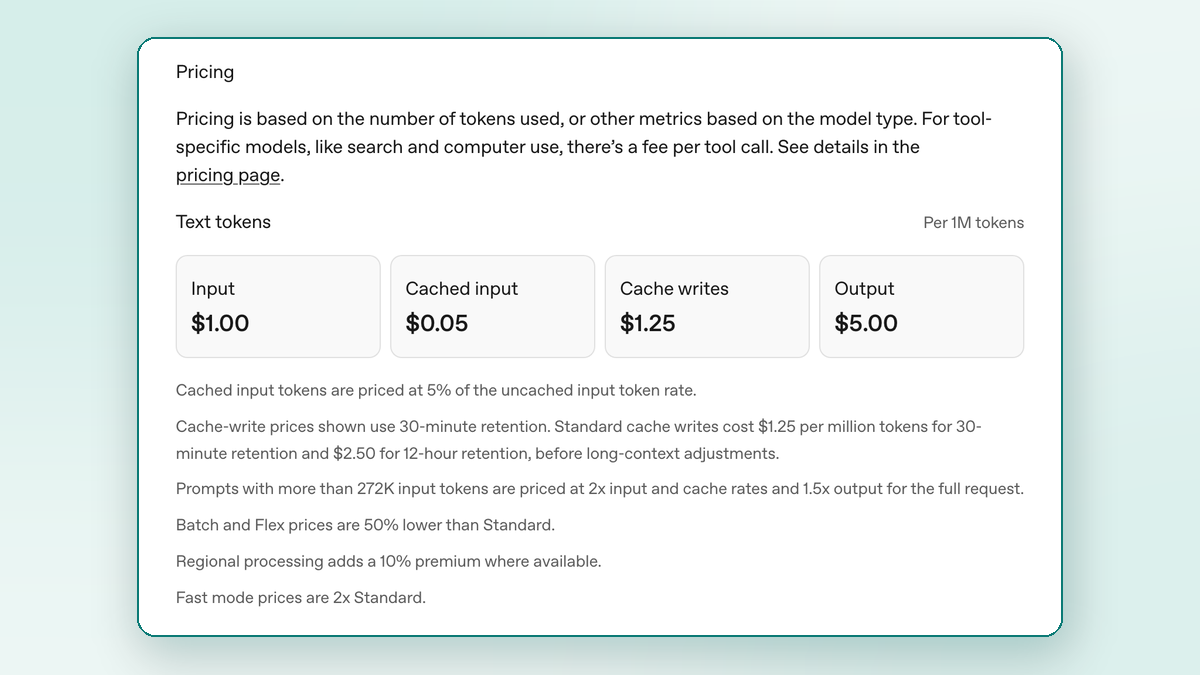
Terra costs $1.00 for input, $0.05 for cached input and $5.00 for output (Source: OpenAI, 2026 — GPT-6.1 Terra docs).
GPT-6.1 Sol costs $2.00 for input, $0.10 for cached input and $10.00 for output (Source: OpenAI, 2026 — GPT-6.1 Sol docs).
The old GPT-5.6 Terra costs $2.00 for input, $0.20 for cached input and $12.00 for output (Source: OpenAI, 2026 — GPT-5.6 Terra docs).
| Model | Input | Cached input | Output |
|---|---|---|---|
| GPT-6.1 Terra | $1.00 | $0.05 | $5.00 |
| GPT-6.1 Sol | $2.00 | $0.10 | $10.00 |
| GPT-5.6 Terra | $2.00 | $0.20 | $12.00 |
So Terra is exactly half the price of Sol on every line.
OpenAI calls the new model 50% cheaper than the old Terra (Source: InfoWorld, 2026 — launch report). Our own sums say that holds for input. On output, the cut is bigger than half.
There are two more price rules worth knowing. Batch and Flex jobs cost 50% less than standard (Source: OpenAI, 2026 — GPT-6.1 Terra docs). So a job that can wait, like a full catalog run overnight, is cheaper still.
The second rule is about very long prompts. Past 272K input tokens, the whole request costs 2x for input and 1.5x for output (Source: OpenAI, 2026 — GPT-6.1 Terra docs).
In plain words, send your catalog in small chunks, not one giant prompt.
There is also a cheaper OpenAI model. GPT-6 Luna costs $0.10 for input and $0.50 for output (Source: InfoWorld, 2026 — launch report).
For simple sorting or tagging, Luna may be enough. Terra earns its higher price when the job needs sharper eyes or more steps.
For context, Claude Sonnet 5.5 costs $2 for input and $10 for output (Source: InfoWorld, 2026 — launch report). That is the same as Sol, and twice the price of Terra.
The headline number comes from a test called Agents' Last Exam. InfoWorld describes it as a benchmark of professional tasks (Source: InfoWorld, 2026 — launch report).
Here are OpenAI's launch charts, as reported by InfoWorld. All of these scores are at the highest effort setting. Terra scored 60.0% at $1.01 per task. Sol scored 58.6% at $2.00. Astra scored 59.3% at $7.24 (Source: InfoWorld, 2026 — OpenAI's launch charts).
The old GPT-5.6 Terra scored 50.7% at $3.58 per task. Claude Opus 5.5 scored the highest, at 63.2%, but it cost $8.82 per task (Source: InfoWorld, 2026 — OpenAI's launch charts).
So the cheaper model beat the dearer one on OpenAI's own test. It did so at about half the cost per task.
Opus 5.5 still came first. But it cost close to nine times as much per task as Terra. For a bulk catalog job, that gap adds up fast.
Medium is Terra's default setting. At medium, Kingy reads OpenAI's chart as 57.6% at $0.29 per task. Astra scored the same at medium, but at $4.82 per task (Source: Kingy AI, 2026 — chart readout).
Now two warnings. First, these are OpenAI's charts, not an outside lab's. Second, the gap between Terra and Sol is small. Treat it as a tie that costs half as much.
One outside reviewer did run a small test of its own. Kingy gave Terra and Sol the same short tasks. Both passed all ten objective attempts. Terra used 2.03 cents of API credit across 12 calls, against 3.80 cents for Sol (Source: Kingy AI, 2026 — Kingy's pilot test).
Kingy says its test was small. It supports trying Terra on short, checkable work, and no more.

For product copy, wrong facts are the real risk. A wrong size in a listing leads to returns.
OpenAI says Terra makes far fewer factual errors than the old Terra. On a set of hard prompts at low effort, the error rate fell from 53.6% to 16.7%. At max effort, it fell to 4.3% (Source: InfoWorld, 2026 — launch report).
Kingy gives the starting point at max effort. The old Terra was wrong on 22.3% of those prompts (Source: Kingy AI, 2026 — factual error readout).
But read the fine print. These prompts were picked because models often get them wrong. Kingy notes that OpenAI's own system card warns against reading them as everyday error rates (Source: Kingy AI, 2026 — factual error notes).
So do not read that last figure as the share of your listings that will be wrong. It only shows the model guesses less. For prices, sizes and claims, a person should still sign off.
Terra is good value. It is not the best model on every test. OpenAI's own charts show two clear gaps.
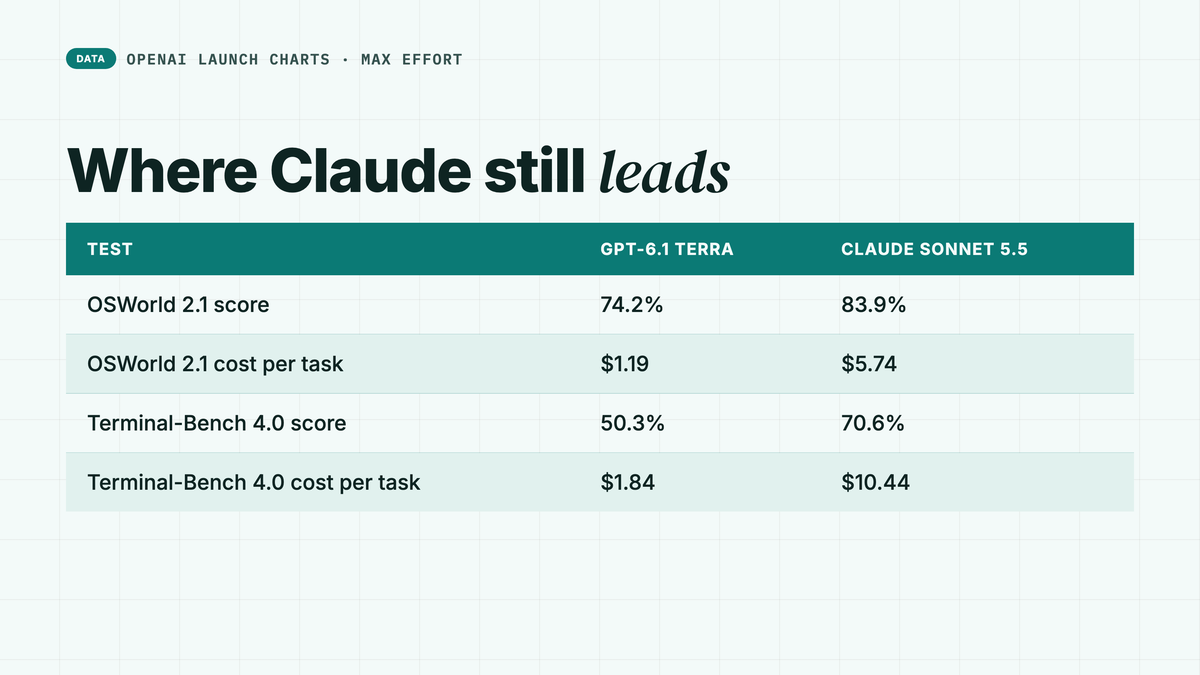
The first gap is screen work. OSWorld 2.1 tests how well an AI agent uses desktop apps over many steps. Terra scored 74.2% at $1.19 per task. Claude Sonnet 5.5 led at 83.9%, at $5.74 per task (Source: InfoWorld, 2026 — OpenAI's launch charts).
Sol scored 78.0% and Astra scored 80.9% on the same test (Source: Kingy AI, 2026 — chart readout). So Terra trails OpenAI's own bigger models here too.
The second gap is coding. On Terminal-Bench 4.0, Terra scored 50.3%. Sol scored 55.9%. Claude Sonnet 5.5 scored 70.6% (Source: Kingy AI, 2026 — OpenAI's launch charts, via Kingy).
That is a gap of about twenty points in Claude's favour. It is too big to ignore if your work involves code.
Kingy also lists the cost per task on that test. Terra cost $1.84. Sonnet 5.5 cost $10.44 (Source: Kingy AI, 2026 — chart readout).
So here is the trade. Claude gets more tasks right on screens and in code. Terra costs much less per task. Which one matters more depends on the job.
For a one-off campaign build, a higher success rate may be worth the money. For thousands of product photos, the cheaper model may win.
One analyst put the cost question well. Sanchit Vir Gogia of Greyhound Research said "Terra's base rates are half Sol's, but review and integration still require funding" (Source: InfoWorld, 2026 — analyst comment).
In plain words, a cheap model that needs a lot of checking is not cheap. Count the review time, not just the token bill.
Here is where we would try Terra first, and where we would not.
Good fits are high-volume jobs with a clear right answer.
Weaker fits are jobs where one mistake costs a lot.
Pareekh Jain of EIIRTrend made a similar list. He called Terra "ideal for high-volume tasks such as invoice processing, document analysis, application automation and routine coding" (Source: InfoWorld, 2026 — analyst comment).
He also said firms should test it on their own work first. We agree.
If you read our guide to GPT-5.6 Sol, Terra and Luna, the advice still holds. Pick the cheapest model that passes your own test.
And if your team already uses ChatGPT Work on signed-in sites, Terra is now one of the models in it.
Any brand can run this test in a week. It needs one person, one product range and API access or a ChatGPT Work seat.
First, pick one product range. Gather its photos, its product sheet and its live listings.
Second, ask Terra to match each photo to the right product. Use the default medium setting to start.
Third, ask it to draft a title and three bullets for each product. Give it your brand's tone guide.
Fourth, check every match and every fact by hand. Count the errors. This step is the real test, so do not skip it.
Fifth, run the same job on the model you use today. Compare the errors, the time taken and the cost.
Sixth, if Terra's errors are high, try the high or max setting. Then compare the cost again.
At the end, you will know three things. How often it matched the right photo. How many facts it got wrong. And what one listing cost to make.
Those three numbers are your business case. They beat any launch chart.

Three things change after this launch.
The first is price. Sol-level agent work now comes at half Sol's price, at least on OpenAI's own test.
The second is the work on offer. OpenAI's docs name catalog matching as a core use. That is an invitation to e-commerce teams.
The third is that no model wins everything. Claude still leads on screen work and coding. Google's Gemini 4 Argon leads on some outside charts.
So stop picking one model for the whole team. Route each job to the model that passes your test at the lowest cost.
Start with one catalog. Measure it. Then decide.
It is OpenAI's new mid-price AI model, launched on 26 October 2026. It replaces GPT-5.6 Terra. OpenAI built it for reading images, using apps and writing clear text.
In the API, it costs $1 per million input tokens and $5 per million output tokens. That is half the price of GPT-6.1 Sol. Batch and Flex jobs cost 50% less.
It is in ChatGPT Work and Codex on the Plus, Pro, Enterprise and Edu plans. Builders can call it in the OpenAI API as gpt-6.1-terra.
On OpenAI's Agents' Last Exam chart, Terra scored 60.0% at $1.01 per task. Sol scored 58.6% at $2.00. Sol still beats Terra on screen work and coding tests.
Not on screen work or coding. On OSWorld 2.1, Claude Sonnet 5.5 scored 83.9% to Terra's 74.2%. On Terminal-Bench 4.0, it was 70.6% to 50.3%. Terra costs much less per task.
OpenAI's docs name matching product photos to catalog entries, acting on app screens and drafting text. For a brand, that means catalog tagging, listing drafts and seller-panel chores.
OpenAI says yes. On its set of hard prompts at max effort, the error rate fell to 4.3%, from 22.3% for the old Terra. Those prompts were picked to be hard, so still check its work.